

Beyond immediate relief, effective care gives clients the skills and tools to keep building on their progress once structured treatment ends, so they can reach a place of lasting stability and avoid needing a higher level of care weeks later. For clinicians, clients, and families alike, this is where outcomes data becomes especially meaningful.
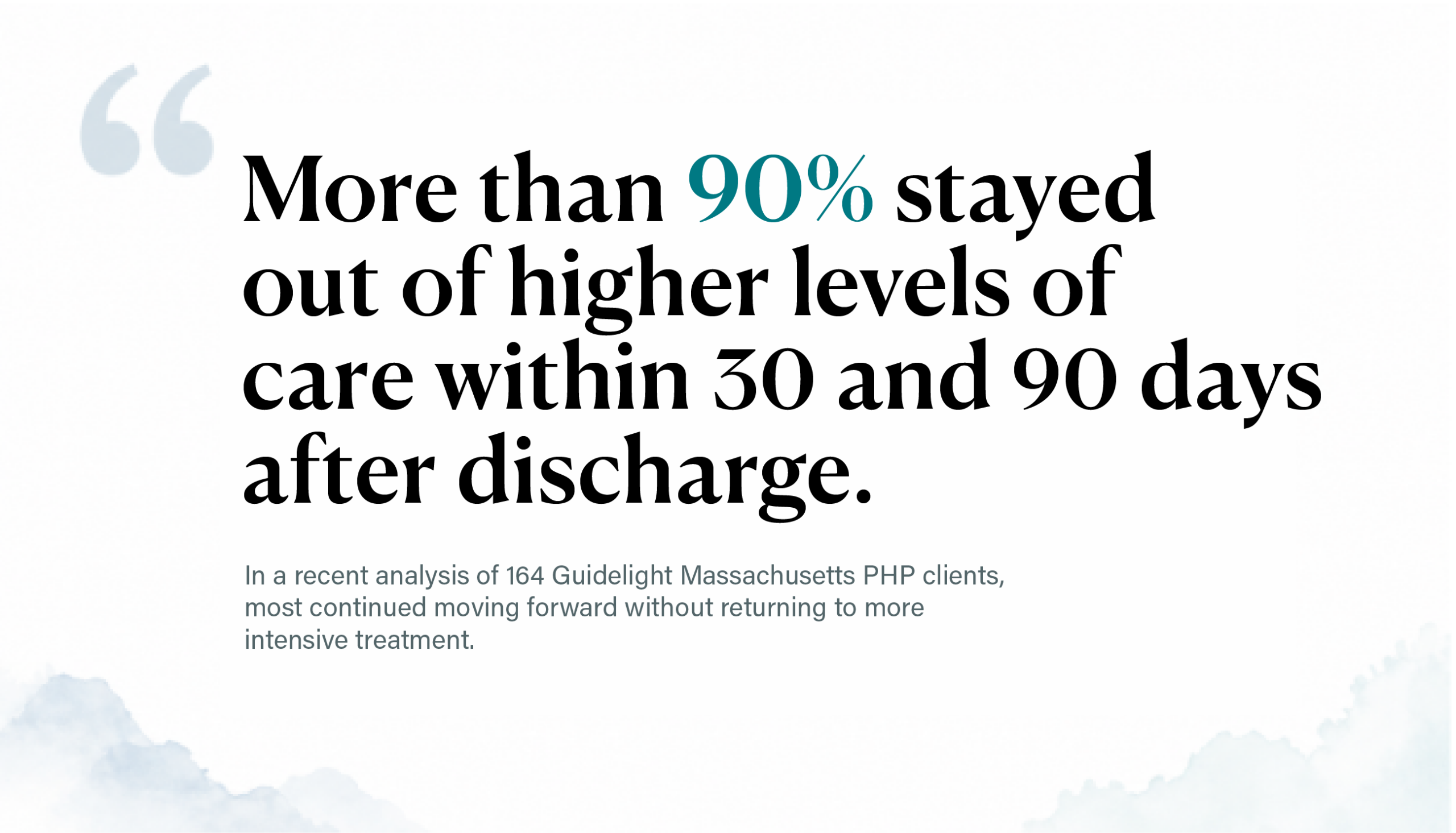
As a national provider of intermediate behavioral healthcare, Guidelight Health offers a Partial Hospitalization Program (PHP) where clients receive intensive treatment without the need for hospitalization. In a recent analysis of 164 Guidelight Massachusetts PHP clients, over 90% stayed out of higher levels of care within both 30 and 90 days after discharge. These results put Guidelight among the strongest performers in intermediate behavioral healthcare. Put simply: clients in the analysis were less likely to return to more intensive treatment after completing PHP because they gained a strong foundation for lasting stability.
Why Staying Stable After PHP Matters
PHP care is designed for people who need more support than weekly outpatient therapy, but who do not require the round-the-clock care of an inpatient or residential setting. As an intermediate level of care, it delivers structured, intensive treatment for several hours a day, five days a week, while enabling clients to return home and stay connected to their lives outside the clinic.
That balance of rigor and independence is exactly what makes PHP a valuable option for clients and referral partners alike. For some clients, PHP provides a step-down after a hospital, residential, emergency, or other higher level of care. For others, PHP can help prevent symptoms from escalating further. In both cases, the goal is not just to attend treatment, but leave with enough support, skills, and structure to keep making progress after discharge and transition into the next stage of care.
For clients and families, discharge means returning to school, work, relationships, and daily routines with the tools and confidence to maintain stability over time. Behind every positive outcome is a person who held onto their progress in the weeks and months that followed PHP care—and a provider who gained measurable assurance that a referral led to lasting improvement.
What the Data Shows
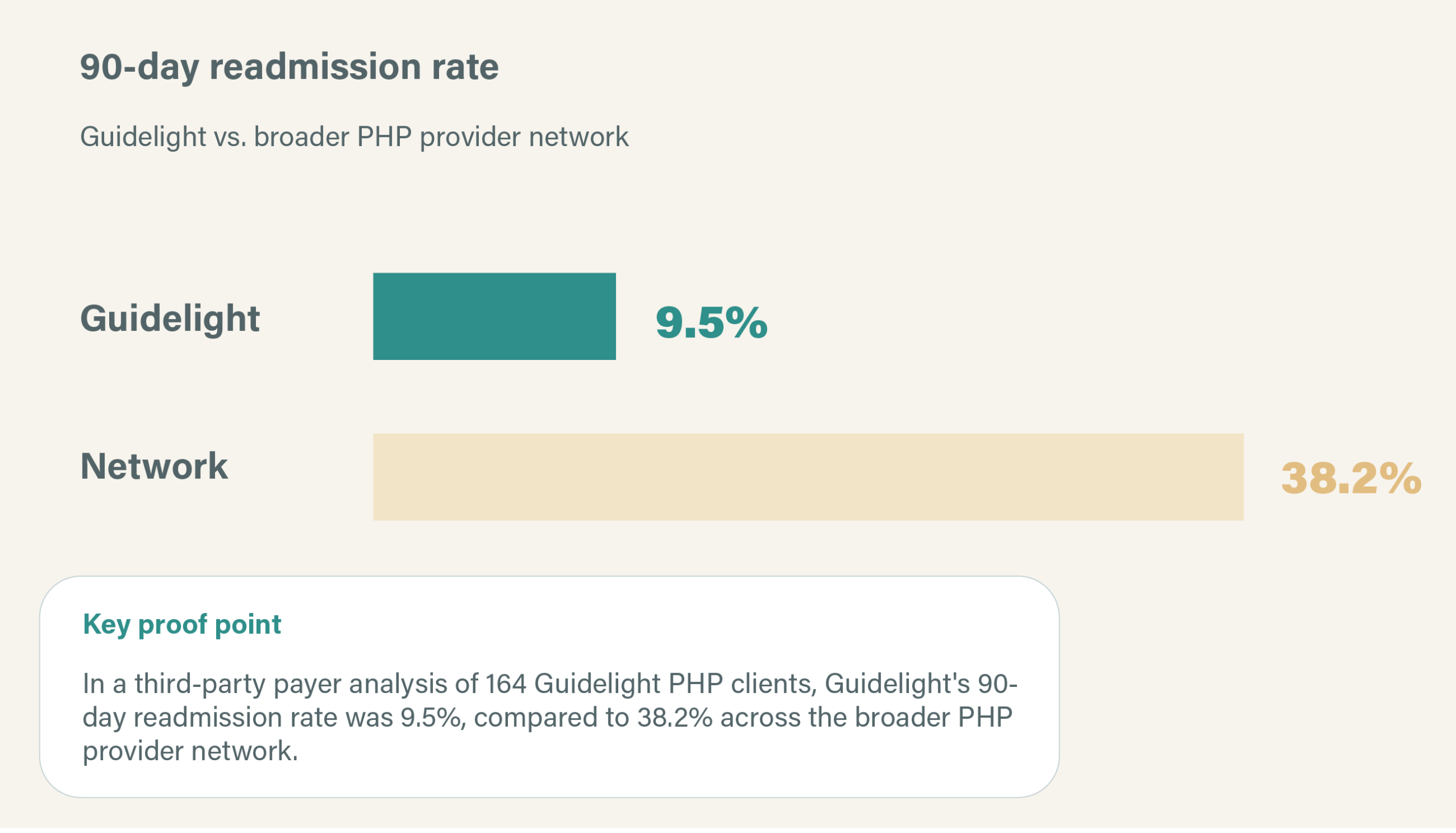
The clearest measure of whether care lasts is what happens once a client completes the program. In the payer analysis, Guidelight PHP clients had a 9.5% return-to-higher-care rate at both 30 and 90 days after discharge, meaning very few clients needed to step back up to a more intensive level of care after completing PHP, a strong sign that the progress they made held.
What’s more, across the broader network, return-to-higher-care rates were 35.6% at 30 days and 38.2% at 90 days. That means more than 90% of Guidelight PHP clients in the analysis stayed out of higher levels of care during both time periods, at a rate far better than the network benchmark.
Guidelight also supports clinical consistency through structured curricula, clinician training, supervision, fidelity monitoring, and continuous outcomes tracking that closes the loop on program success. By measuring how clients are doing throughout care and after discharge, Guidelight can see what is working, adjust what is not, and hold every clinic to the same standard. That structure matters because lasting progress takes more than a schedule of services.
What This Means for You
Deciding whether PHP is the right level of care can feel overwhelming. For families, PHP may be appropriate when someone is experiencing significant anxiety, depression, trauma symptoms, emotional dysregulation, functional decline, or difficulty staying stable with weekly therapy alone.
Likewise, PHP care may also be appropriate when someone is transitioning from a more intensive setting and needs a stronger pathway back to everyday life. The right level of care always depends on clinical need, and Guidelight can help talk through what is happening and whether PHP or Intensive Outpatient Program (IOP) care provides the next best step for a client’s healing journey.
For many clients, PHP is the start of that pathway rather than the end of it. Stepping down into IOP continues the same skills-based, clinically guided care at a lower intensity, giving clients time to apply what they’ve learned as they return to daily life. Completing the full continuum, not just the first phase, is what helps the gains made in PHP hold over time.
For therapists, psychiatrists, hospitals, schools, primary care teams, community providers, and other referral partners, the hardest question is rarely whether a client needs care, but where they can receive the appropriate level of support in a timeframe that matches the urgency of their need. When a client needs intensive, skills-based, psychiatry-supported care with a clear transition plan, Guidelight offers an effective intermediate step—providing the structure and rigor clients need without the restriction of inpatient or residential care.
Not sure if PHP is the right fit?
Guidelight can help assess clinical fit and talk through next steps.
Data note: Based on a recent third-party payer analysis of 164 Guidelight Massachusetts PHP clients. Guidelight PHP clients had a 9.5% return-to-higher-care rate at both 30 and 90 days after discharge, compared with 35.6% at 30 days and 38.2% at 90 days across the broader network. Higher levels of care may include inpatient, residential, or another more intensive treatment setting. Guidelight PHP average length of stay was 7.8 days compared with a broader network average of 9.7 days.